Most grounding material is written for a slightly better day than the one you are having. It asks you to notice your breath, name five things you can see, and generally assumes you have a spare few minutes and a mind willing to cooperate. That describes a mild state of activation on a calm afternoon.
This is written for the other case: the phone-call-your-boss-just-ended, the child screaming in a shop, the message you cannot stop rereading, the moment where you are shaking slightly and cannot think in sentences. The goal here is not to feel calm in ninety seconds. It is to get one degree below the peak, because most of what makes these moments so bad is that everything you decide inside them is decided from the worst possible baseline.
Why the first thirty seconds are the important ones
A panic-adjacent state is not primarily a thinking problem. The alarm system has taken over: heart rate up, breathing shallow and high in the chest, attention narrowed to the perceived threat, and the capacity for perspective temporarily offline. That is why insight does nothing in the moment. You can already see exactly what is happening and it makes no difference.
The lever that does work is physical, and it works because it addresses the physiology directly rather than asking you to talk yourself round.
The order below is not arbitrary. Cold first, because it is the fastest way to interrupt the physiology. Weight second, because it grounds attention in a place you can feel. Breath last, because breathing is easier to change once the first two have taken some of the charge off.
Step one: cold, ten seconds
This is the least elegant and most effective step.
- Run cold water over your inner wrists, or
- Press a cold glass or a bag of frozen vegetables against your neck and forearms, or
- If you are outside, hold a cold object — a metal railing, a stone — in both hands
The mechanism is a dive reflex, which is the fastest autonomic response the body has and which is difficult to activate deliberately. Cold on the face, hands, or neck is the reliable route. It takes about ten seconds and the effect tends to start before you finish.
If you are somewhere public or in a bathroom at work, this is one of the few things you can do with nobody noticing.

A suggested tool
A glass you keep filled on the bedside table
Keeping the water where you already are removes the only step in the morning that could go wrong. Refill it at night and it is available before you have decided to get up.
View on AmazonThis page may contain affiliate links to products we think are worth considering. If you buy through a link, we may earn a small commission at no extra cost to you. Our recommendations are independent, and they are suggestions, not prescriptions.
Step two: weight, twenty seconds
Stand up if you can. If you cannot, that is fine, do it sitting.
- Press both feet flat into the floor, hard, for ten seconds
- Then lift your heels, hold, and put them down slowly
- Do it three times
What you are doing is giving your attention a sensory task that is dull, physical, and has a clear finish. This is not relaxation. It is a distraction that happens to be an honest one — your attention cannot be in the spiral and in your heels at the same time, and the body follows the attention.
If you are in a public place this reads as fidgeting. That is acceptable.
Step three: breath, forty seconds
Now, not first.
- Breathe in through your nose for four
- Out through your mouth for six
That ratio is the entire instruction. The longer exhale is what shifts you out of the high-chest pattern, and it does not require much air.
Make it audible — the exhale is the part that matters most, and if you can hear yourself doing it you will extend it without deciding to. This is also why this works in a car, a stairwell, or a bathroom: it sounds like someone sighing.
A suggested tool
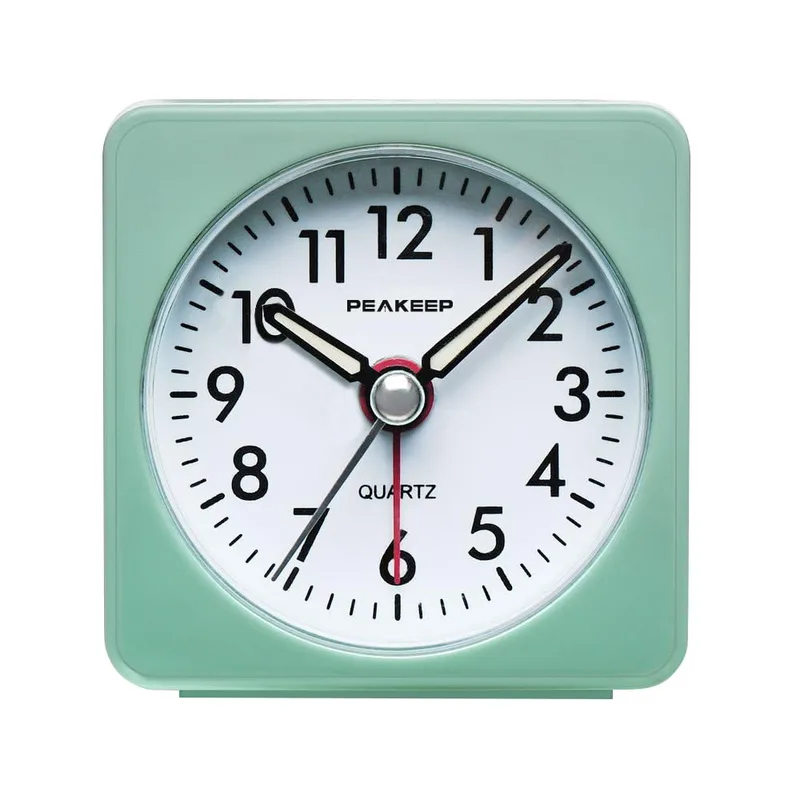
A small clock you can see from where you write
Ten minutes is long enough to drift and short enough to feel like a commitment. A visible clock is the simplest way to keep the promise honest, especially in the first few weeks.
View on AmazonThis page may contain affiliate links to products we think are worth considering. If you buy through a link, we may earn a small commission at no extra cost to you. Our recommendations are independent, and they are suggestions, not prescriptions.
If you find that counting makes it worse, drop the numbers and just make the exhale longer than the inhale. That is the whole technique.
Step four: one sentence, twenty seconds
Only after the above. While the alarm is still present, this part will feel stupid — write it in advance if that helps.
Name the thing in one plain sentence. Not “I am having a panic response about my job” — that is a paragraph. Something like: I am frightened and my body is reacting.
The reason it works is narrow and specific: it moves you from being a state to describing one, which is a small but real shift in position. Naming the physical event also stops the mind from composing the catastrophe narrative in the background while you are trying to breathe.
Then stop. Do not write the situation down, do not solve it, do not decide whether to email anyone. All of that can wait forty minutes and will be better at it.
What not to do in the first ninety seconds
- Do not reason your way out. Argument, reassurance, and analysis all require the part of the brain that has gone offline. They also give the spiral something to hold onto.
- Do not re-read the message or the email. Repetition confirms the threat and refreshes the physiological response each time.
- Do not decide anything permanent. Decisions made at the peak are reliably worse than decisions made an hour later, and you will know this while still being unable to act on it.
- Do not drink coffee. Caffeine is a physiological accelerant and this is a physiological problem.
Afterwards
The peak is usually over in a few minutes. The residue is the more common problem: a shaky, flattened feeling and a strong urge to either apologise to someone or go to sleep.
Both are normal and neither needs a decision. Drink water, because you probably have not for hours. Do not debrief the situation for at least half an hour, and if you do debrief it, do it with someone rather than in your own head.
Our 90-second nervous system reset goes into the physiology more carefully, and how to end self-reflection feeling grounded is for the part that comes after, when you have overthought it and landed somewhere more depleted than you started.
This is a self-reflection resource, not a therapeutic intervention. The techniques here are drawn from widely used grounding practices and are not a substitute for care. If these states are frequent, if they come with fainting or physical symptoms, or if they are interfering with your life, please speak to a qualified health or mental-health professional.
Further reading
- 90-second nervous system reset — the physiology behind the exhale, explained without jargon.
- Feeling safe in your body — for the longer version, used after the spike passes.
- Somatic exercises: gentle ways to begin — a slower, body-first approach for days when this is not an emergency.
- Burnout or overload: a gentle check-in — when the pattern behind these spikes is worth looking at.
Sources
- Your breathing and your nervous system — how respiratory patterns interact with autonomic states.
- Grounding techniques in trauma care — the US Department of Veterans Affairs on grounding methods.
- Mammalian dive reflex and vagal tone — peer-reviewed work on cold exposure and vagal response.
Continue gently
Vagus Nerve Reset Exercises for Everyday Regulation
Three slow-exhalation exercises that engage your parasympathetic system, with honest notes on what vagus nerve work can and cannot do.
Nervous System Regulation: A Gentle Guide for Everyday Overwhelm
What nervous system regulation can mean in everyday life, how to begin gently, and when self-care is not enough.
Somatic Exercises for Beginners: Gentle Ways Back to the Present
Five low-pressure, non-clinical body-based practices for noticing the present moment without forcing calm or revisiting difficult memories.